
OPENING QUESTION:
OBJECTIVES: I will be able to:
| (1) Indicate the direction of magnetic forces on a current-carrying loop of wire in a magnetic field, and determine how the loop will tend to rotate as a consequence of these forces. |
| (2) Calculate the magnitude and direction of the torque experienced by a rectangular loop of wire carrying a current in a magnetic field. |
Notice our key terms "magnitude & direction"
WORDS/FORMULAE FOR TODAY
TERMS
- Magnetic Field (B): A vector value
- Magnetic Force (FB): Also a vector
CONSTANTS:
UNITS:
- Tesla = T defined as 1 N/C(m/s)
FORMULAE:
- FB = qv x B
- FB = qvB
- FB = qvBsinθ
- FB = IL x B
- FB = ∫I ds x B NOTE: AP Version is: FB = ∫I dℓ x B
- v = E/B
- τ = IAB (torque in a current carrying loop)
- τ = NIA x B (torque in a current carrying loop - vector version)
- τ = μ x B (torque in a current carrying loop - abbreviated version)
- KE = q2B2R2/2m
WORK O' THE DAY:
Please turn in your take home test *now* <thank you>
════════════════════
M/c O' the Day:
Thomas-- You're Up!
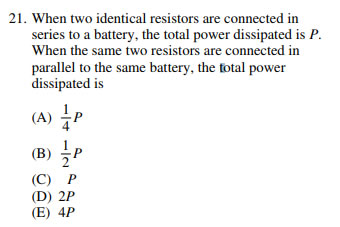
2012 Released Exam #21
════════════════════
Oh and AFTER today, please shoot me a screen shot of your question, so I can add it to our study guides.
Notice that one of the formulations that we kinda worked through on Friday was this:
FB = ∫I ds x B NOTE:
AP Version is: FB = ∫I dℓ x B
What do you suppose is happening on the microscale when we do such an integration?
════════════════════
Imagine that you have a square loop of wire placed in a magnetic field as shown:

Each person in your group pick a side of the wire loop (1 - 4)
Make a PREDICTION as to how that side of the loop will be impacted in the setup shown.
Now combine your thoughts and predict what will happen to the loop as a whole!
════════════════════
Notice that sides 1 & 3 are in the direct line of the magnetic field so they experience no magnetic force since
FB = qvsinθ.
So:
Fb1 and Fb3 = 0 N
Notice also that sides 1 & 3 each result in a force in opposite directions. Using our usual conventions we would then say that:
Fb2 is in the +k direction
while on the other hand:
Fb4 is in the -k direction
Wait a sec... doesn't that sound like τORQUE????
Indeed, let's take a gander
Notice that animation shows the vectors acting on the loop NOT NECESSARILY the motion of the loop
════════════════════
Now let's take a look at the math!
For a loop enclosing a specific area as shown above, the max magnitude of the torque is simply:
τ = IAB
or using vectorage to find the entire quantity:
τ = IA x B 
Our most-gracious-and-humble-author goes to kind of exhaustive length to tell us that we can include the number of loops (N) of wire to help us along to find the full vector quantity:
τ = NIA x B
Where N is the number of loops of wire
I is the current
A is the area formed by the loop
Notice that the book replaces IA with the term magnetic moment μ
Which means we can rewrite that as:
τ = μ x B
There are two learning targets covered here; and it looks like this does pop up a wee bit on the test, so let's keep in mind the two checked equations above.
Take a gander at THIS released m/c question:

The answer is C.... why is th
Doesn't it look like that is more of a question to gauge your understanding of cross products (generally)??
════════════════════
On first blush it may seem that the equation:
IA x B
is nowhere to be found on our equation sheets... hmmmmmmmm
Perhaps we can (quickly?) derive that from known equation(s). Try that now please.
════════════════════
HOMEWORK: 29.46, 48, 51 (this one has a tricky part, come in tomorrow prepared to discuss why:
1) we use sine even though we're finding the magnitude of the torque only
2) the angle we use for sin ain't θ